
G’day friends and hello to my new subscribers👋
Well, June has certainly crept up on us! It is a bittersweet month for me because it’s the start of summer ☀️ in the northern hemisphere (which I wholeheartedly welcome!), but it’s also the start of endless Refugee Week/World Refugee Day campaigns. I was born into a family of refugees so it feels a bit overwhelming at times! #trauma
This month, I have the honour of featuring Youmna El Sayed, a Palestinian-Egyptian journalist and former Gaza correspondent for Al Jazeera. You might have seen clips of Youmna doing live-crosses as Israeli forces decimated buildings around her. Because of her reporting, she now lives in exile with her family in Egypt.
Youmna is unwavering and an absolute force. We had a long chat about foreign correspondents, neutrality, learning the craft from scratch in Gaza, and motherhood.

Can you tell me about your journey into journalism?
I actually graduated from university with a languages and translation degree, but I've always wanted to be a journalist. I didn't study that in college.
Journalism is about telling the stories of people. People who don't have the privilege to be out there, to speak about their own stories, about what they're going through. And me having that privilege - being able to bring out the voices of the people, to speak about them, to tell their stories to the world - this is what journalism means for me.
I was living in Egypt before my university years and then I moved to Gaza permanently with my husband in 2014.
Gaza was like no other place in the world. It was a place that you can only see in the news in times of war. So, I felt like, no, the world needs to know the hidden stories. They need to understand the happy stories of the people, the culture of the people, how they find moments of happiness out of basically nothing.
How did you learn the craft of journalism and the technical skills?
I had to do a lot of self-studying honestly and it wasn't easy. I didn't have the privilege to go to university again because I had my own family life at that time. I had two babies and I felt like studying from home online while taking care of my kids was the only chance I had. I think the passion I had for this job overcame any obstacles and difficulties in life.
How did you learn to work with traditional newsrooms from Gaza?
Every single network or channel or organisation I worked with had their own style. And to be successful working with them, you had to acquire their style in writing and in reporting, what to focus on, what not to focus on, the terminology to use, the stories to pitch and so on.
But there was always this one thing I kept with everyone that makes me Youmna: I wanted to focus on the truth. So, regardless of the story I'm reporting on, journalism should not favour who to speak about and who not to speak about, right? Or to hide the truth about certain topics. I don't want to frame the truth. I want to speak about it the way it is.
So, for example, when rockets were being fired from Gaza, I didn't think twice about whether I should report about this or not. As long as I'm doing this job, then I have to report the truth as it is.
Facts, evidence, and truth comes first. It's not up to you to say whether this is right or wrong. Always focus on the fact that the audience is putting their trust in you. What protects your reputation as a journalist is the fact that you're saying the truth at all times.
This leads me to my next question. What do you think it means to be “unbiased” and “impartial”?
When I came out of Gaza, I was always being asked this question. What does bias mean? Are you neutral? What does neutrality mean? Being objective means that I will report about all the events equally. I will report on both sides equally with the truth.
If you go back to my reporting on the 7th of October, I was reporting on the events exactly as they happened. You're responsible for the people who put their trust in you, right? Presenting them with the truth actually is in your favour.
The meaning of neutrality is to detach yourself from your emotion when you're reporting on something. But how many Western journalists were neutral when they went to Ukraine and reported about the civilians being killed or injured or displaced? How many of them were neutral? None.
Some went to the point of saying, ‘These are Europeans. They're not Arabs. They're not third-world country civilians. These people look like us. They have blue eyes and blonde hair.’ They let themselves be human beings and speak with emotion about what they are seeing.
So, how can you ask me - someone who is reporting about my own family, my own neighbourhood, my own colleagues, my own friends, my own neighbours, the streets I walked in for years - how can you ask me to speak without emotion about them?
Any foreign journalist in the world - no matter how professional he is - if they come to Gaza, they'll need a Palestinian fixer, translator, a Palestinian producer. So, what makes their story more credible than my story?
I’m a Palestinian speaking the language of the Western world and reporting live from there, about things that I am living myself? What makes you more credible than me? Have you learnt to speak my language and communicate with the people going through this in our language so that you can do the job yourself?
What advice would you give an aspiring journalist who, like you, might not have access to traditional journalism training?
All these trainings and skills development for journalists, they're not available in Gaza. So you have to do your thing by yourself. It's like you're living in another era, really. Everything is difficult, everything is from scratch there. I've never had any kind of journalism training. People think that, "Oh, you're a very good journalist and your reporting is very good." This is because of me doing that, working so hard to get here.
You can definitely learn online. You can improve yourself. We can learn by watching other journalists do their job, reading, listening. I had to learn how to write a script by listening to other journalists.
It's going to be harder than the traditional way of just going to journalism school and getting access to all these professional trainings. But it should never be an obstacle. Nothing is an obstacle, honestly. This is the thing that I've learned from Gaza: that there is no obstacle in life.
How did you start working with Al Jazeera?
I was freelancing with a lot of channels and I was covering the 2021 war. I was doing lives for different channels during the day. I was on the rooftop of one of the buildings, al-Jalaa tower where Al Jazeera and the AP offices were, and the attack of the tower opposite me started.
The missiles started falling on that huge building, and the shrapnel started flying towards us because it was just a couple of metres away. I had to duck down quickly and my cameraman and assistant ran away for cover.
I turned the camera with my hand towards the explosion so that the presenter could see what was happening and I continued reporting while I was on the ground right there under the camera trying to take cover from the shrapnel that was flying.
And right after that live happened, I got a call from Al Jazeera saying that they want me to be their exclusive correspondent because of how I dealt with that incident.
Why did you ultimately leave Gaza?
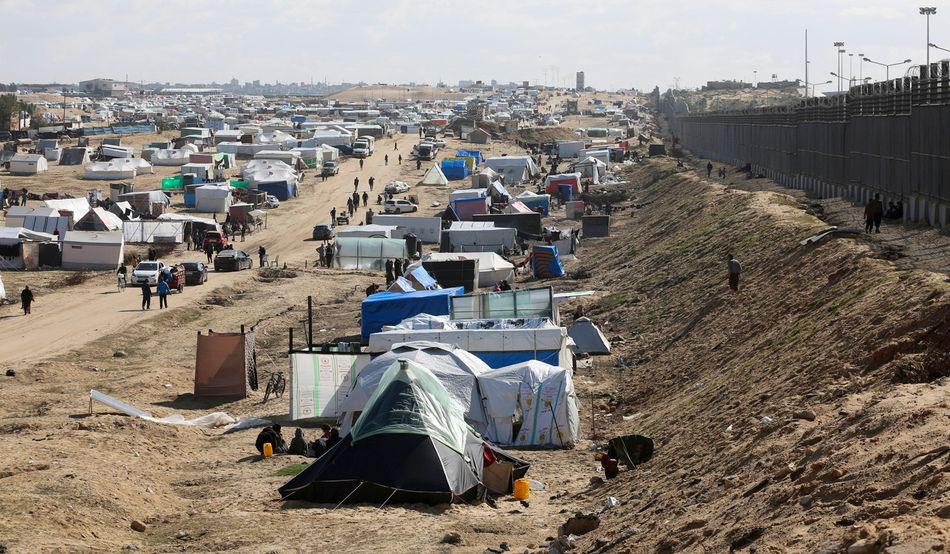
I didn't want to leave but I left Gaza in order to protect my family and my kids. I was threatened in my home in Gaza City. I was under siege for a whole week, under relentless bombardment. And then the day that I was allowed to leave, I left under sniper bullets and tank shells. I was given five minutes to leave the building with my children and my husband before they opened fire again.
This is the kind of terror that nobody knows about.
Leaving Gaza at the time wasn't a choice. It wasn't a decision that I made as a professional. It was as a mother, you know? It was choosing between being a journalist and a mother. And this was something my mum told me when she was in Egypt. She said, “This is the time that you have to choose between being a journalist or a mother because you can't be both.”

Why do you think it's important for people of colour to stay in journalism?
Human beings deserve their stories to be told with emotion. I think this is the most successful way of reporting because for a lot of people around the world, they comprehend, they understand, they relate more when the story touches their hearts. And if it's without emotion, it will never touch their hearts.
Journalists of colour from different backgrounds, each and every one of us feels differently, operates differently, has different thoughts and ideas and perspectives. And that's what brings this industry to life. It's not just one kind of colour, one kind of taste, one kind of style.
How do you find joy? What protects your energy?
So many times I felt like I was breaking down. That I couldn't take it anymore. I always tell myself no matter how tired I am, I would just sleep. If I get a good sleep, I wake up rested.
The more I saw people suffering, the more I persisted to go on. And this was my only way to go on. So it's either you let the suffering of the people around you break you and ruin you, or you turn it into strength to go on, to continue reporting about them, to continue telling their stories, to keep going on, to keep standing. This was my motivation. This is what honestly kept me going.
The suffering is still ongoing, the war is still ongoing, the genocide is still ongoing. I continue my reporting in a different way, maybe in a sort of activism way. But for me, I’m still telling the stories of the people in a truthful way.
I cover other things here in Egypt that are going on with the Palestinian population that is in exile now and how they live and because otherwise nobody would know about it.
Throughout my childhood and early 20s, I actively hid my family background from others. Yet Youmna says those differences bring journalism to life. I guess it’s time to lean into those hidden parts of us unapologetically?
See you all next month,
Lin
Suggest a journalist for me to interview by filling out this simple, anonymous form!
Feel free to forward this newsletter to your friends and colleagues, or share it on LinkedIn🙏🏽
And if you were forwarded this newsletter, you can sign up here or catch up on the other journalists I’ve featured so far.
Email: [email protected]
LinkedIn: @lintaylor
Instagram: @lintaylorjourno
What I’ve been checking out lately:
👵🏻 I watched a funny and beautiful Thai film, ‘How To Make Millions Before Grandma Dies’. When I say “watched”, I mean I cried for 2 hours. This broke my heart and mended it again. The granny in this film reminded me of my late granny, who also had a bad temper (and swore like a sailor). I miss her so much.
🗞️ This investigation by The Londoner absolutely gripped me. “A decayed corpse was found being wheeled through the centre of Walthamstow. Who was she? And who is to blame for her death?”
☂️👯 I listened/watched this podcast episode of ‘Good Hang with Amy Poehler’ featuring Tom Holland and felt so unexpectedly joyous afterwards!
❤️ There is this wonderful artist/storyteller @AnaKrutch who I recently discovered on Instagram. She tells the most magical and poignant stories through illustrations and comics. What a gift she is.
